
Tyre Puncture vs Tyre Damage: When Do You Need a Replacement?
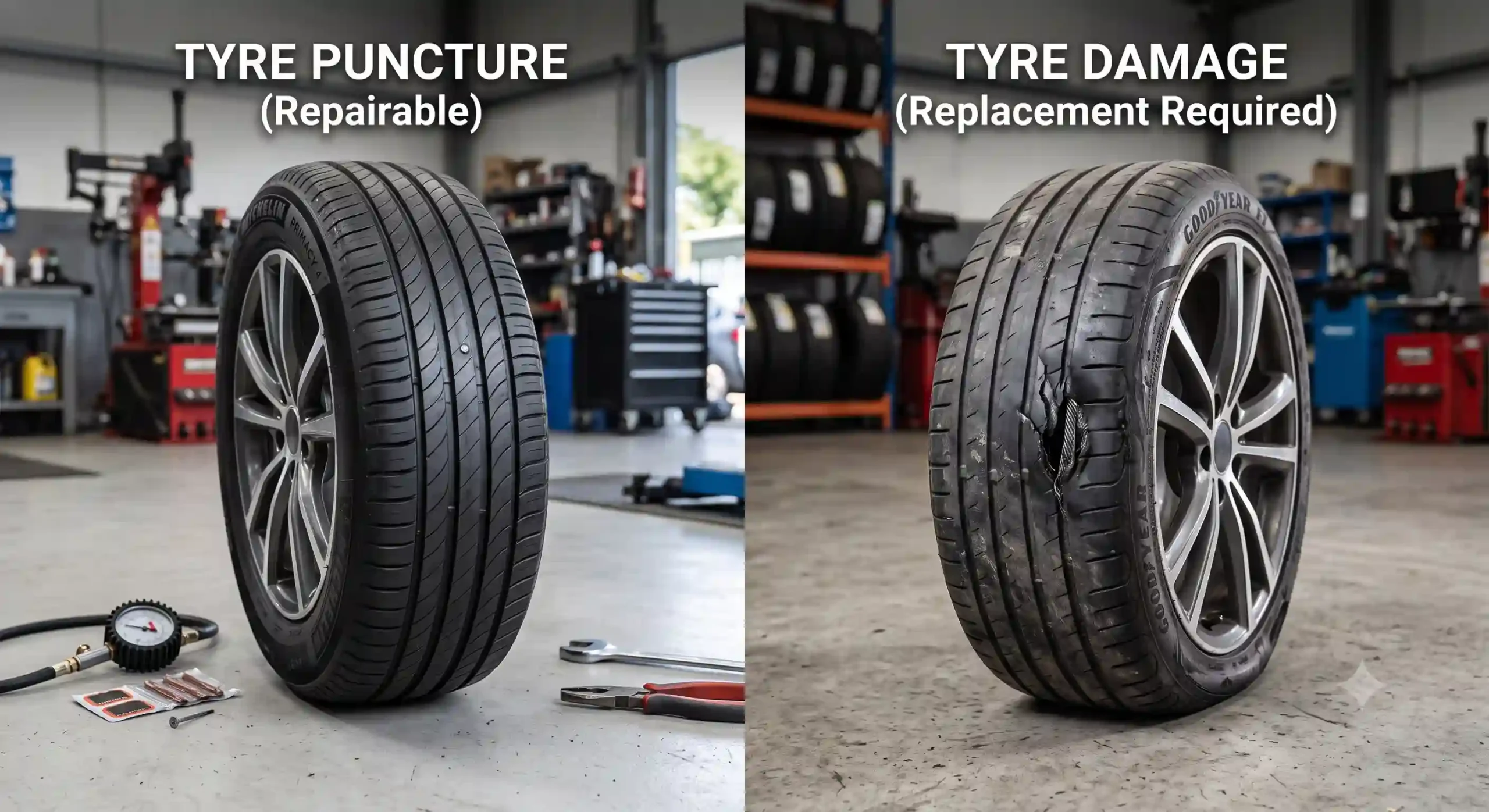
A punctured tyre does not always mean you need a completely new tyre. In some cases, a puncture can be professionally repaired and the tyre can safely return to the road. In other situations, the tyre may have suffered additional damage that makes repair unsuitable, meaning replacement is the safer option.
This is why it is important to understand the difference between a tyre puncture and tyre damage rather than assuming that every tyre problem can be fixed in the same way.
A small nail or screw in the central tread area may sometimes be repairable, while a damaged sidewall, serious cut, bulge, exposed cords or evidence of driving on a severely underinflated tyre can mean that the tyre needs replacing. TyreSafe states that permanent puncture repairs should be carried out by a tyre specialist following the applicable British Standard and only after the tyre has been removed from the wheel for proper internal and external inspection.
For London drivers, knowing when to choose tyre puncture repair in London and when to arrange a replacement can save unnecessary expense while also helping you avoid driving on a tyre that is no longer suitable for use.
FlatFix Tyre provides mobile puncture repair , mobile tyre fitting and emergency tyre replacement at suitable locations across London.
What Is the Difference Between a Tyre Puncture and Tyre Damage?
The terms puncture and damage are sometimes used interchangeably, but they do not necessarily describe the same problem.
A tyre puncture normally refers to a hole or penetration that allows air to escape from the tyre. A common example is a nail, screw or other sharp object entering the tread. Depending on the size and location of the puncture, the tyre may lose air quickly or develop what is known as a slow puncture.
Tyre damage is a broader term. It can include punctures, cuts, cracks, sidewall damage, bulges, impact damage, exposed cords, bead damage and deterioration caused by age or incorrect inflation.
This distinction matters because a puncture may sometimes be repairable, whereas other forms of tyre damage may require replacement.
For example, imagine finding a small screw embedded in the central tread of an otherwise healthy tyre. After professional inspection, the tyre may meet the requirements for repair.
Now compare that with a tyre that has a large cut across the sidewall or has developed a visible bulge after hitting a pothole. That is a different type of problem, and simply repairing the hole would not address the underlying structural damage.
Can Every Tyre Puncture Be Repaired?
No. A puncture is not automatically repairable simply because the hole looks small.
A tyre specialist needs to consider several factors before deciding whether a repair is appropriate. These include:
- Where the puncture is located
- The size and nature of the damage
- The condition of the tyre
- Whether the tyre has been driven while underinflated
- Whether there is internal damage
- The tread condition
- Whether previous repairs have been carried out
- Whether the tyre has other cuts, cracks or structural defects
TyreSafe explains that permanent repairs should follow BS AU 159 and that the tyre should be removed from the wheel so it can be inspected internally as well as externally.
This is important because a tyre can sometimes look reasonably normal from the outside while having damage inside the casing.
That is one reason why simply pulling a nail out of a tyre and plugging the hole yourself is not the same as having the tyre professionally assessed.
 A tyre inspection helps determine whether a puncture is suitable for repair or whether replacement is necessary.
When Is a Tyre Puncture Usually Repairable?
A puncture may be suitable for repair when the damage is limited and the rest of the tyre remains in suitable condition.
One of the most important considerations is where the puncture is located.
TyreSafe states that permanent puncture repairs can only be carried out in the central three-quarters of the tyre tread. Damage affecting the sidewall or outside the permitted repair area may mean the tyre cannot be repaired.
For example, a small nail that has entered the central tread area may be a candidate for professional repair.
However, even in this situation, the tyre should still be inspected properly.
The technician needs to establish whether the tyre has been driven while significantly underinflated and whether there is any hidden internal damage.
This is why a professional tyre puncture repair in London should involve more than simply finding the object and sealing the visible hole.
When Does a Puncture Mean You Need a New Tyre?
A tyre may need to be replaced when the damage is too severe or is located in an area where a safe permanent repair cannot be carried out.
Replacement may be necessary if the tyre has:
- Sidewall damage
- A large or severe cut
- Significant cracking
- A bulge or deformation
- Exposed cords
- Bead damage
- Serious casing damage
- Severe deterioration
- Damage caused by driving while underinflated
- Unsuitable previous repairs
- Insufficient tread or other significant wear
TyreSafe specifically lists casing, bead, sidewall-type damage, cracking, exposed cords and damage caused by under- or over-inflation among conditions where a tyre should not be repaired.
The key point is that the puncture itself is only one part of the assessment.
A small puncture in a healthy tyre can be very different from a small puncture in a tyre that has already suffered structural damage.
Why Driving on a Punctured Tyre Can Make Things Worse
One of the biggest mistakes drivers make is continuing to drive because the tyre still appears to contain some air.
A slow puncture may allow you to continue driving for a while before the problem becomes obvious, but that does not mean the tyre is safe to keep using.
As air pressure falls, the tyre can deform more than it should. This can affect handling and braking and can increase the possibility of further tyre damage. TyreSafe advises drivers to have suspected punctures assessed by a professional rather than simply continuing to drive on them.
The situation can become particularly serious if the tyre eventually becomes completely flat.
Driving on a severely underinflated or flat tyre can cause damage that was not present when the original puncture occurred.
This is why dealing with a puncture early can sometimes mean the difference between repairing the tyre and replacing it.
What Is a Slow Puncture?
A slow puncture is a tyre that gradually loses air rather than suddenly becoming completely flat.
You may notice that one tyre needs inflating more often than the others. The car may still appear to drive normally, so it can be tempting to keep adding air and carry on.
However, repeatedly inflating the tyre does not solve the underlying problem.
A slow puncture can be caused by a nail or screw in the tread, a valve problem, damage around the bead or damage to the tyre or wheel. TyreSafe identifies sharp objects, pothole or kerb impacts and valve problems among possible causes of gradual air loss.
If one tyre repeatedly loses pressure, it is better to have the cause investigated.
For more information, read our related guide:
What Causes a Car Tyre to Lose Air?
Can a Nail or Screw in a Tyre Be Repaired?
Sometimes, yes.
A nail or screw in the central tread does not automatically mean the tyre has to be replaced.
However, you should not assume that removing the object is enough.
Once the object is removed, air may escape more rapidly, and the tyre may have already suffered damage from being driven while losing pressure.
A tyre specialist needs to inspect the tyre and determine whether the puncture is within a repairable area and whether the tyre remains structurally suitable.
TyreSafe notes that a nail or screw in the tyre may potentially be repaired, but more severe or multiple tears may make repair unsuitable.
If you have discovered a nail or screw in your tyre, avoid unnecessary driving and arrange an inspection.
 Professional inspection helps determine whether a punctured tyre can be repaired or needs to be replaced.
What Tyre Damage Means You Should Replace the Tyre?
Not all tyre damage looks the same.
Some problems are relatively obvious, while others require a professional inspection.
Sidewall Damage
The sidewall is one of the most important areas of the tyre because it flexes as the vehicle moves.
Cuts, serious cracking, bulges or other structural damage to the sidewall can mean the tyre is unsuitable for repair.
A sidewall puncture is also different from a straightforward tread puncture. The fact that a hole appears small does not mean it can safely be repaired.
Tyre Bulges
A bulge or bubble on the sidewall can indicate internal structural damage.
This type of problem should not be treated as a cosmetic defect.
If you notice a significant bulge, avoid unnecessary driving and arrange professional inspection.
A tyre with structural damage may need replacement rather than puncture repair.
Cracks in the Tyre
Cracking can occur as rubber deteriorates over time.
Small surface marks may need to be assessed in context, but significant cracking, particularly when accompanied by other signs of ageing or damage, can mean the tyre is no longer suitable for continued use.
TyreSafe notes that cracked tyres cannot simply be repaired because the underlying rubber deterioration is a different problem from a straightforward puncture.
Exposed Cords
If you can see cords or other internal tyre material through the tread or sidewall, the tyre should not be treated as an ordinary puncture repair.
Exposed cords indicate significant damage or wear and can compromise the tyre's structure.
Replacement may be required.
Damage After Hitting a Pothole or Kerb
A pothole or kerb impact can cause more than a simple puncture.
The impact can damage the tyre, wheel or both.
You may notice:
- A sudden loss of pressure
- A bulge in the sidewall
- A cut or split
- Steering changes
- Vibration
- Wheel damage
- Repeated pressure loss
If your tyre became damaged immediately after a strong impact, it is worth having the complete wheel and tyre assembly inspected rather than assuming that fitting a new tyre will automatically solve everything.
FlatFix Tyre also provides wheel balancing where appropriate after tyre and wheel work.
Can You Repair a Tyre That Has Been Driven Flat?
This is an important question because driving on a flat tyre can create additional internal damage.
A tyre may have started with a relatively small puncture, but if the driver continues for a significant distance with very low pressure, the internal structure may become damaged.
That damage may not be visible simply by looking at the outside of the tyre.
This is why TyreSafe recommends removing the tyre from the wheel for a thorough internal and external inspection before carrying out a permanent repair.
In other words, a puncture that might initially have been repairable may no longer be suitable for repair after being driven while severely underinflated.
If you have driven on a flat tyre, tell the technician what happened so the tyre can be assessed appropriately.
Tyre Puncture Repair vs Tyre Replacement: Which Do You Need?
The easiest way to understand the difference is to look at the overall condition of the tyre rather than focusing only on the puncture.
| Situation | Possible Outcome |
|---|---|
| Small puncture in suitable tread area | May be repairable |
| Nail or screw in central tread | May be repairable after inspection |
| Sidewall puncture | Usually replacement |
| Serious sidewall cut | Replacement may be required |
| Large tear | Replacement |
| Visible bulge | Replacement |
| Exposed cords | Replacement |
| Severe cracking | Replacement |
| Significant internal damage | Replacement |
| Puncture plus severe wear | Replacement may be more appropriate |
| Tyre driven while severely underinflated | Requires professional inspection; replacement may be necessary |
This is why there is no single answer to “Can my punctured tyre be repaired?”
The technician needs to inspect the tyre and determine whether it meets the relevant repair requirements.
What Should You Do If Your Tyre Is Losing Air?
If you notice that one tyre is losing air, do not simply keep topping it up indefinitely.
Start by checking the pressure against the vehicle manufacturer's recommended pressure.
Then look for obvious signs such as a nail, screw, cut or bulge.
However, avoid putting yourself in danger to inspect or repair a tyre at the roadside.
If you are already travelling and notice a significant change in steering, handling or tyre pressure, reduce your speed carefully and look for a safe place to stop.
The Highway Code advises that tyre pressure should be checked regularly and notes that under-inflated tyres can adversely affect steering and braking. It also advises only changing a tyre when doing so can be done without putting yourself or others at risk.
If the vehicle cannot safely be driven to a tyre centre, mobile tyre fitting can be a practical alternative.
What Should You Do If You Get a Puncture in London?
A puncture is inconvenient enough without having to drive across London looking for a tyre centre.
If you discover a puncture at home, work, in a car park or at a suitable roadside location, the first step is to assess whether the vehicle can safely remain where it is.
If the tyre is significantly deflated or damaged, avoid unnecessary driving.
Instead, arrange professional assistance.
FlatFix Tyre provides tyre puncture repair in London, along with mobile tyre fitting and emergency tyre replacement for suitable locations.
The technician can assess the tyre and determine whether the problem is suitable for repair or whether a replacement is required.
This can be particularly useful when you do not have a spare wheel, do not have the correct equipment or cannot safely drive the vehicle to a traditional tyre centre.
You can also read:
Mobile Tyre Fitting vs Garage: Which Is More Convenient?
Does a Puncture Repair Mean You Do Not Need a New Tyre?
Not necessarily.
If a tyre is suitable for repair, a professional repair can avoid replacing a tyre unnecessarily.
But the decision should be based on the actual condition of the tyre.
A repair should not be used simply because replacing the tyre is more expensive.
If the tyre has structural damage, severe wear, sidewall damage or other defects, replacement may be the appropriate solution.
The purpose of a professional inspection is therefore not simply to find the cheapest option. It is to establish whether the tyre can safely remain in service.
What About Tyres That Keep Getting Punctures?
If the same tyre repeatedly develops problems, there may be an underlying issue.
For example, repeated pressure loss could be related to:
- A recurring puncture
- Valve problems
- Bead sealing problems
- Wheel damage
- Tyre deterioration
- Previous repair problems
- Incorrect tyre pressure
Simply repairing the visible problem each time may not address the underlying cause.
If you keep finding that the same tyre is losing air, arrange an inspection of both the tyre and wheel.
What About Run-Flat Tyres?
Run-flat tyres need to be considered separately from conventional tyres.
They are designed to provide limited mobility after a loss of pressure, but the permitted speed and distance depend on the tyre and vehicle manufacturer's instructions.
They should not be treated as ordinary tyres that can simply be driven indefinitely after losing pressure.
TyreSafe also notes that driving a run-flat while deflated can place significant stress on its structure and may make the tyre unsuitable for repair.
If your vehicle uses run-flat tyres, follow the manufacturer's guidance and arrange a professional inspection.
FlatFix Tyre provides run-flat tyre services for suitable vehicles and tyre requirements.
What About the TPMS Warning Light?
A tyre pressure monitoring system, or TPMS, can warn you when a tyre's pressure has fallen.
The warning should not simply be ignored because the vehicle still appears to drive normally.
A slow puncture may initially produce very little noticeable change in handling.
If the TPMS warning appears, check the tyre pressures as soon as it is safe to do so and investigate why the pressure has changed.
FlatFix Tyre also provides TPMS checks as part of its mobile tyre services.
Can a Temporary Puncture Repair Kit Replace a Proper Repair?
No.
A temporary repair kit can sometimes help you reach a suitable location, but it should not be confused with a permanent professional tyre repair.
TyreSafe describes emergency puncture repair kits as temporary measures and advises that a tyre should receive professional attention afterwards.
You should also follow the specific instructions supplied with your vehicle's repair kit.
If the roadside location is unsafe, do not attempt to use a repair kit there. Seek appropriate assistance instead.
When Should You Choose Emergency Tyre Replacement?
Emergency tyre replacement may be appropriate when the tyre cannot safely be repaired.
Examples can include serious sidewall damage, severe cuts, structural damage, a dangerous bulge, exposed cords or damage resulting from driving on a severely deflated tyre.
The replacement tyre also needs to be suitable for the vehicle and match the required specification.
FlatFix Tyre provides emergency tyre replacement in London for suitable situations, subject to tyre availability, location and safe working conditions.
If the tyre can be repaired safely, repair may be an option. If it cannot, replacement provides the appropriate route back to a usable tyre.
How to Avoid Turning a Puncture Into a Tyre Replacement
You cannot prevent every puncture, but you can reduce the chance of a minor problem becoming a larger one.
Check your tyre pressures regularly and follow the pressure recommendations supplied by your vehicle manufacturer.
Inspect the tyres for obvious cuts, cracks, bulges and objects embedded in the tread.
Do not ignore a tyre that repeatedly loses pressure.
And if you suspect a puncture, avoid unnecessary driving.
This is particularly important because continuing to drive on a significantly underinflated tyre can cause additional damage.
The earlier a puncture is professionally assessed, the easier it is to determine whether repair is possible.
For general tyre safety advice, you can also read our guide:
7 Signs Your Car Tyres Are Unsafe to Drive On
How FlatFix Tyre Can Help With a Puncture or Damaged Tyre
A tyre problem does not always mean you need to drive to a tyre centre.
FlatFix Tyre provides mobile tyre services across London, allowing suitable tyre work to be carried out at a home, workplace, car park or appropriate roadside location.
Depending on the condition of the tyre, the service may involve:
Mobile Tyre Fitting
Mobile tyre fitting allows a technician to come to a suitable location rather than requiring you to drive a vehicle with a damaged tyre to a garage.
Puncture Repair
Mobile puncture repair is available where the puncture and overall tyre condition are suitable for a professional repair.
Emergency Tyre Replacement
If the tyre cannot safely be repaired, emergency tyre replacement can provide a replacement where the required tyre is available.
Wheel Balancing
If tyre or wheel work is carried out and balancing is required, wheel balancing is also available for suitable vehicles and locations.
Tyre Supply & Fit
If you need a replacement rather than a repair, tyre supply and fit can provide a suitable tyre according to the vehicle's requirements.
Tyre Puncture vs Tyre Damage: The Main Difference
The most important thing to remember is that a puncture and tyre damage are not always the same problem.
A puncture may be a relatively limited penetration in an otherwise healthy tyre. Depending on its location and condition, it may be suitable for professional repair.
Tyre damage can be much broader.
A damaged sidewall, bulge, serious cut, exposed cord, significant cracking or internal damage may mean that repairing the original puncture is not enough.
The tyre needs to be assessed as a whole.
That is why it is better to have a professional determine whether a tyre should be repaired or replaced rather than making the decision based solely on the size of the visible hole.
Need Tyre Puncture Repair in London?
Found a nail, screw, slow puncture or damaged tyre? FlatFix Tyre provides mobile puncture repair, mobile tyre fitting and emergency tyre replacement at suitable locations across London.
The tyre can be assessed to determine whether repair is suitable or whether replacement is required.
Puncture Repair Contact FlatFix TyreFrequently Asked Questions
1. Is a punctured tyre always replaceable?
No. Some punctured tyres can be professionally repaired if the damage and overall tyre condition meet the relevant requirements. Others need replacement because of their location, severity or additional damage.
2. Can a nail in a tyre be repaired?
A nail in the suitable central tread area may be repairable after professional inspection. The tyre should not simply be plugged or repaired externally without proper assessment.
3. Can a sidewall puncture be repaired?
A sidewall puncture generally cannot be treated as a standard tread puncture repair. TyreSafe states that permanent repairs are limited to the central three-quarters of the tread, meaning damage in the sidewall area may require replacement.
4. How do I know if my tyre needs replacing?
Signs can include serious sidewall damage, bulges, exposed cords, severe cracking, significant cuts, structural damage or damage caused by driving while underinflated.
5. Can I drive with a slow puncture?
A slow puncture should not be ignored. Continued driving while the tyre loses pressure can affect handling and may cause further damage. Arrange a professional inspection as soon as reasonably possible.
6. Can driving on a flat tyre damage it?
Yes. Driving on a severely underinflated or flat tyre can cause additional internal and structural damage, potentially turning a repairable puncture into a tyre that needs replacement.
7. Can a tyre be repaired after hitting a pothole?
It depends on the damage. A pothole can damage both the tyre and wheel, so the complete assembly should be inspected before deciding whether repair or replacement is appropriate.
8. Is a tyre bulge repairable?
A significant tyre bulge can indicate internal structural damage and should not be treated as an ordinary puncture. Professional inspection is required and replacement may be necessary.
9. What is the difference between puncture repair and tyre replacement?
Puncture repair deals with suitable limited puncture damage while retaining the tyre. Replacement involves removing the damaged tyre and fitting another suitable tyre when repair is not appropriate.
10. Does FlatFix Tyre provide tyre puncture repair in London?
Yes. FlatFix Tyre provides mobile puncture repair at suitable locations across London, subject to the condition and suitability of the tyre for repair.
11. Does FlatFix Tyre replace damaged tyres?
Yes. FlatFix Tyre provides mobile tyre fitting and emergency tyre replacement for suitable vehicles and locations, subject to tyre availability.
12. Can I use a puncture repair kit instead of replacing my tyre?
A temporary repair kit may help you reach a suitable location in appropriate circumstances, but it should not automatically be treated as a permanent repair. Professional assessment is still required.
13. Should I keep driving if my tyre keeps losing air?
No. Repeated pressure loss is a sign that the tyre or wheel needs to be investigated. Continuing to drive on a significantly underinflated tyre can create additional problems.
14. Can a tyre look fine but still be damaged?
Yes. Some internal damage cannot be identified from a simple external visual inspection. This is one reason professional puncture assessment involves inspecting the tyre internally as well as externally.
15. Is tyre puncture repair cheaper than replacement?
A repair can avoid the cost of a replacement tyre when the tyre is genuinely suitable for repair. However, safety and tyre condition should determine whether repair is appropriate rather than price alone.
16. Can FlatFix Tyre come to my home for a puncture?
Yes. Mobile tyre services can be useful when a vehicle is at home, work, a suitable car park or another location where the vehicle can be safely accessed.
Need Help With a Punctured or Damaged Tyre?
If you are unsure whether your tyre needs a repair or replacement, FlatFix Tyre can assess the tyre at a suitable location across London.
Call: 07347 120201
Email: info@flatfixtyre.com