What Causes a Car Tyre to Lose Air?
What Causes a Car Tyre to Lose Air?
A car tyre that keeps losing air is a problem that should not be ignored. You may inflate the tyre in the morning and find that the pressure has dropped again a few days later, or you may discover that one tyre is noticeably lower than the others when you are about to start a journey.
Sometimes the cause is obvious, such as a nail or screw that has penetrated the tread. In other situations, the source of the air loss can be much harder to identify. A damaged valve, a leak where the tyre meets the wheel, a damaged wheel, an ageing tyre or a previous puncture repair can all allow air to escape gradually.
Understanding why a car tyre loses air can help you recognise when the problem needs professional attention rather than simply continuing to add air.
In this guide, we explain the most common causes of tyre pressure loss, what a slow puncture can look like, why one tyre may keep losing air, whether you can drive on a tyre that is losing pressure and what to do if you need professional tyre assistance.
If one tyre repeatedly loses pressure, there is usually an underlying reason that needs to be investigated.
Continuing to inflate the tyre without identifying the cause can allow a puncture, valve problem, wheel damage or another defect to continue unnoticed.
If the tyre has lost significant pressure, appears damaged or feels unsafe, avoid unnecessary driving and arrange appropriate professional assistance.
If you are dealing with a flat tyre on a London road, our guide explains what you can do and how to get help:
Why Is My Car Tyre Losing Air?
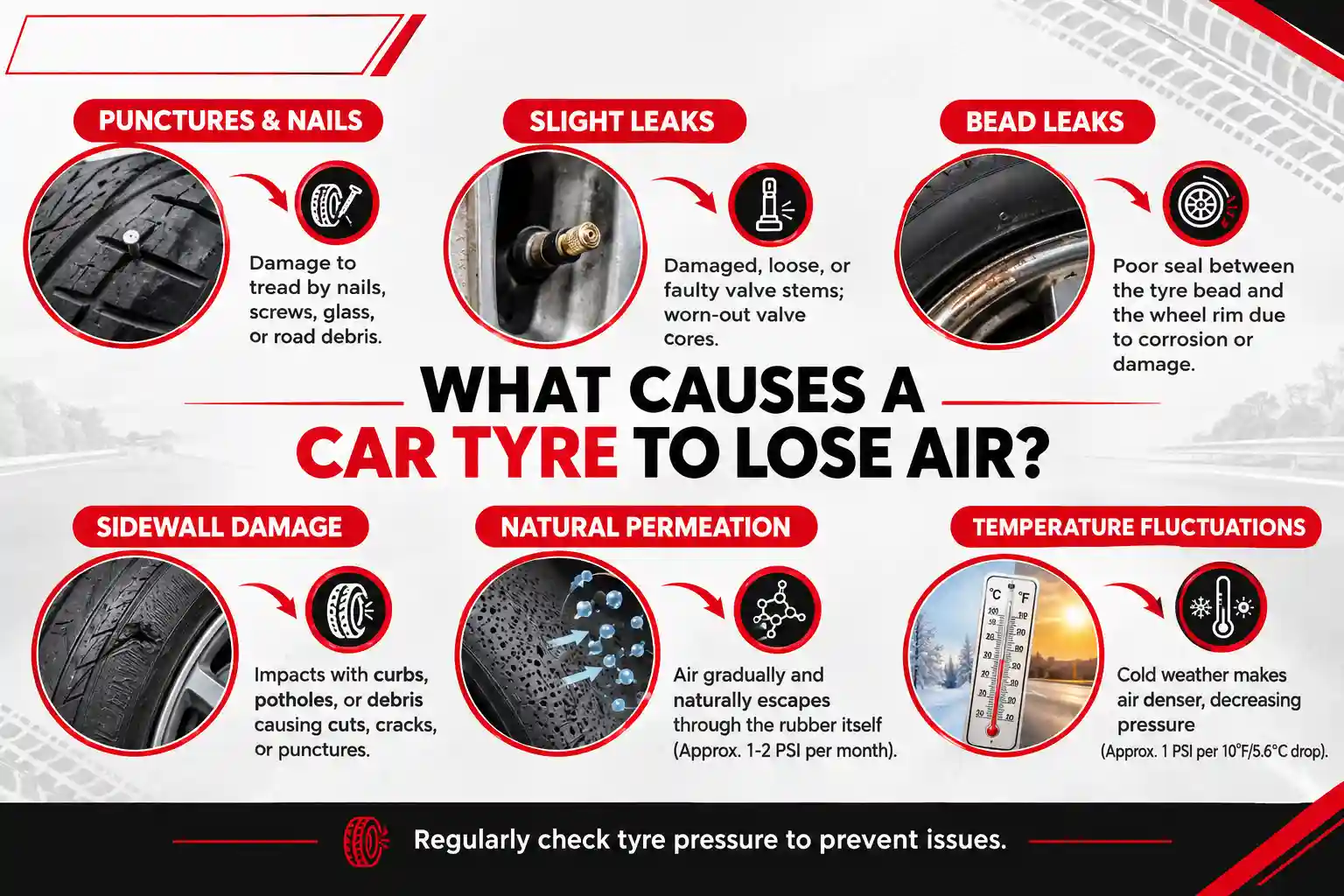
There are several reasons a tyre can gradually or suddenly lose pressure. The most common causes include punctures, valve leaks, damage where the tyre seals against the wheel, wheel damage, sidewall damage and deterioration of the tyre itself.
Temperature changes can also affect the pressure shown by your tyre-pressure gauge, although temperature-related pressure changes are different from an actual physical leak.
The important distinction is whether the tyre is simply experiencing a normal change in pressure or whether air is escaping because there is a fault somewhere in the tyre, valve or wheel assembly.
If the same tyre continues to lose pressure while the others remain relatively stable, that is a strong reason to have the tyre and wheel checked.
1. A Nail or Screw Has Caused a Slow Puncture
One of the most common reasons for a car tyre to lose air slowly is a puncture caused by a nail, screw or another sharp object.
A small object can remain lodged in the tread and allow air to escape gradually rather than causing the tyre to become completely flat straight away. This means you may continue driving for several days without immediately realising there is a problem.
You might notice that the tyre looks slightly lower than the others, the tyre-pressure warning light appears, or you need to inflate the same tyre repeatedly.
In some cases, the object may be clearly visible in the tread. In other cases, the puncture may be small enough that it is difficult to identify without a proper inspection.
Does a Nail Always Mean the Tyre Needs Replacing?
No. A puncture does not automatically mean that a tyre must be replaced.
Whether a tyre can be repaired depends on factors such as the location and size of the puncture, the condition of the tyre and whether the tyre has been driven while significantly underinflated.
A professional inspection is therefore important before deciding between puncture repair and tyre replacement.
If you suspect that a puncture is causing your tyre to lose air, you can learn more about our puncture repair service .
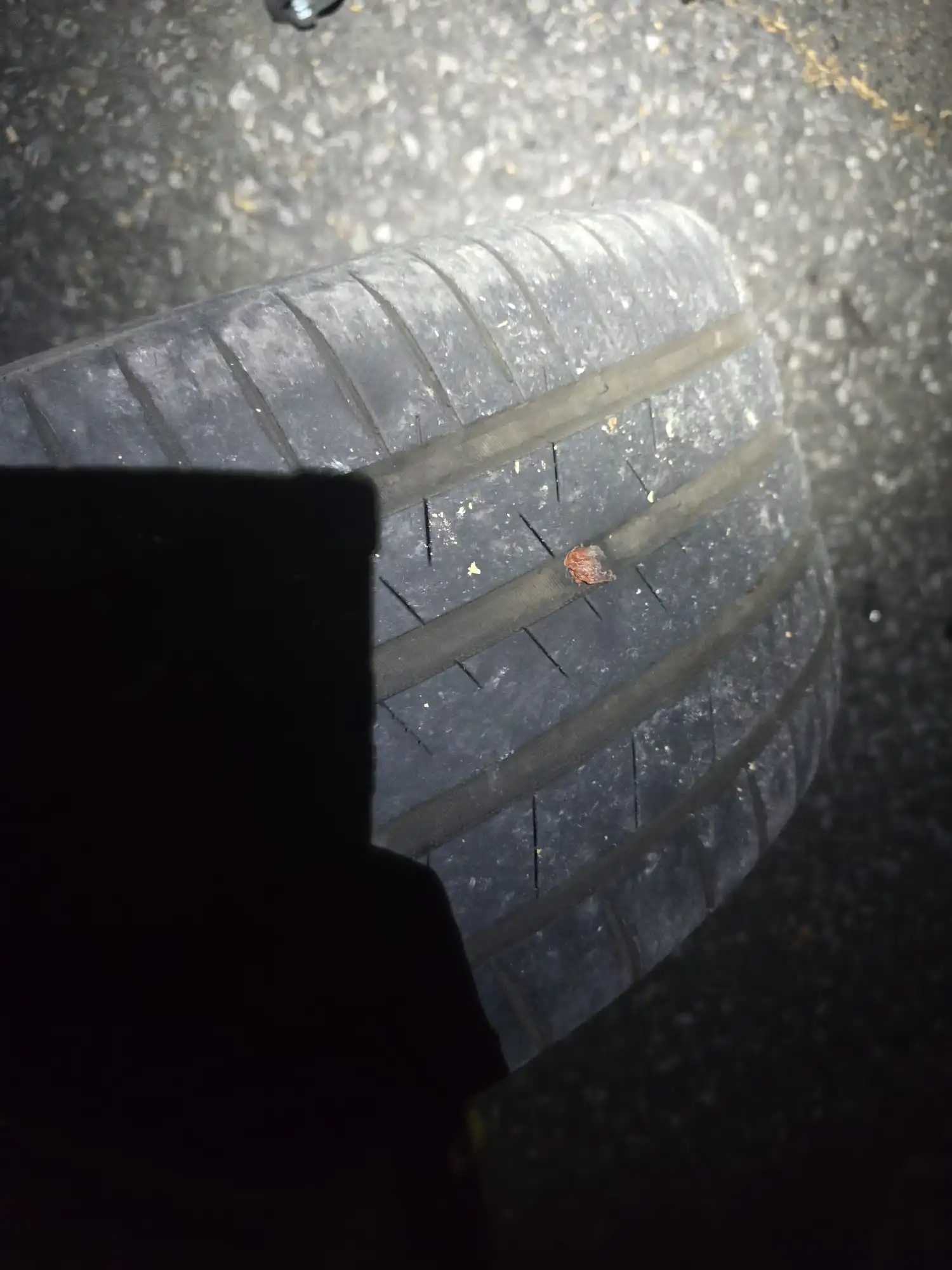 A slow puncture can cause gradual pressure loss even when the tyre does not appear completely flat.
2. The Tyre Valve Is Leaking
Another possible cause of a tyre losing air is a problem with the valve. The valve is responsible for allowing the tyre to be inflated while helping to keep the air inside once the correct pressure has been reached.
If the valve becomes damaged, worn or faulty, air can escape gradually. The leak may be small enough that you do not immediately notice it, but over time the pressure can fall enough to affect the way the vehicle drives.
Valve problems can sometimes occur after tyre fitting, through general wear or because the valve components have deteriorated over time.
A valve leak can be particularly frustrating because there may be no obvious nail, screw or cut in the tread. The tyre itself may look perfectly normal while still losing pressure.
If the tyre has been inspected and no obvious tread puncture can be found, the valve and valve area should also be checked.
3. There Is a Leak Between the Tyre and the Wheel
Air can also escape from the area where the tyre seals against the wheel. This part of the tyre and wheel assembly is commonly referred to as the bead area.
A poor seal can develop because of corrosion, dirt, damage to the wheel, damage to the tyre bead or other problems affecting the contact between the tyre and wheel.
This type of leak can be difficult to identify by simply looking at the tyre. The tyre may remain inflated for a while but gradually lose pressure over several days or weeks.
If you repeatedly inflate the same tyre and there is no obvious puncture, the wheel and bead area may need to be inspected for an air leak.
A bead leak can be slow enough that the tyre does not become visibly flat overnight. You may simply notice that the pressure is consistently lower than expected whenever you check it.
Professional inspection can help establish whether the air is escaping through the tread, valve, bead area, wheel or another part of the tyre assembly.
4. A Pothole or Kerb Has Damaged the Wheel
A tyre does not always lose air because the rubber itself has been punctured. A strong impact with a pothole or kerb can damage the wheel and create conditions that allow air to escape.
A damaged wheel may affect the seal between the tyre and wheel, resulting in gradual pressure loss.
You may also notice other symptoms after a significant impact, including steering vibration, unusual handling or a change in the way the vehicle feels at certain speeds.
Not every pothole impact causes visible damage, which is why repeated pressure loss after hitting a pothole should not be ignored.
If your tyre began losing air after an impact, the tyre and wheel should be inspected rather than assuming that the problem is simply normal pressure loss.
5. The Tyre Has Sidewall Damage
The sidewall of a tyre can become damaged through impacts, contact with kerbs, incorrect use, ageing or other forms of deterioration.
Cuts, cracks, bulges and other visible defects can indicate that the tyre needs professional assessment.
A damaged sidewall can sometimes be associated with air loss, but the more important concern is that certain types of sidewall damage can affect the structural condition of the tyre.
A tyre with a significant bulge, deep cut or serious structural defect should not simply be inflated and treated as normal.
If you notice unusual tyre damage, avoid making assumptions based only on the fact that the tyre is still holding some air. A professional inspection can determine whether the tyre is suitable for continued use.
 Sidewall damage can be difficult to judge without professional inspection, particularly after a pothole or kerb impact.
6. The Tyre Is Old or Deteriorating
Tyres are made from rubber compounds and other materials that naturally deteriorate over time. Exposure to sunlight, weather, temperature changes and normal use can all contribute to ageing.
As a tyre ages, you may notice cracking, hardening, changes in appearance or other signs of deterioration.
Age alone does not automatically mean that every tyre is unsafe or leaking air. However, an older tyre showing visible deterioration deserves closer attention, particularly if it is also losing pressure.
If you are unsure whether your tyres are approaching the end of their usable life, our detailed guide explains the signs that can indicate when replacement may be appropriate:
How to Know When Your Car Tyres Need Replacing
7. Temperature Changes Have Changed the Tyre Pressure
Not every reduction in tyre pressure means that there is a puncture or physical leak.
Changes in temperature can affect the pressure inside a tyre. For example, colder conditions can cause tyre pressure readings to fall compared with readings taken in warmer conditions.
This is why it is important to check tyre pressure when the tyres are cold and compare the readings with the vehicle manufacturer's recommended pressures.
However, temperature changes should not be used to explain away persistent pressure loss in one particular tyre.
If one tyre keeps losing pressure while the others remain relatively stable, the tyre, valve, wheel and bead area should be checked for an actual leak.
8. The Tyre Pressure Was Incorrectly Set
A tyre may also appear to be losing pressure because it was not inflated to the correct pressure in the first place.
Tyre pressure should be set according to the vehicle manufacturer's recommended specification rather than simply using a general pressure that works for another vehicle.
The correct pressure can vary depending on the vehicle, tyre specification and loading conditions.
Driving with incorrect tyre pressure can affect tyre wear, handling and the way the vehicle responds on the road.
If you regularly check the tyre and find that the pressure is lower than expected, it is important to establish whether the tyre is actually leaking or whether the original pressure was incorrect.
9. A Previous Puncture Repair Is Leaking
A tyre that has previously been repaired can sometimes develop another problem in the repaired area or elsewhere on the tyre.
If a tyre was repaired after a puncture and later begins losing air again, it should be inspected rather than assuming that the repair simply needs more air added.
The condition of the repair, the surrounding tyre and the original puncture location all need to be considered.
A tyre that has experienced repeated punctures or repeated pressure loss may also require closer assessment to determine whether repair remains appropriate or whether replacement is necessary.
Why Is My Tyre Losing Air But There Is No Puncture?
This is a common question from drivers who have checked the tread and cannot see a nail, screw or obvious hole.
A tyre can lose air without having an easily visible tread puncture. The cause may be a leaking valve, a bead leak, wheel damage, sidewall damage or another problem that cannot be identified through a quick visual inspection.
This is why simply looking at the tread is not always enough when investigating repeated tyre pressure loss.
If the tyre keeps losing air, a technician may need to inspect the complete tyre and wheel assembly to identify the source of the leak.
If you cannot find a nail or screw but the tyre continues to lose pressure, do not assume that the pressure loss is harmless. The source of the leak may be located somewhere other than the visible tread area.
Why Does One Tyre Keep Losing Air?
If only one tyre repeatedly loses pressure while the other tyres remain at approximately the correct pressure, it is worth investigating that specific tyre rather than simply adjusting all four tyres more frequently.
One tyre repeatedly losing air can indicate a slow puncture, valve problem, bead leak, wheel damage, tyre deterioration or another fault.
For example, you may inflate the front-left tyre to the correct pressure and find that it is noticeably lower again after several days. If this pattern keeps happening, the repeated pressure loss is a useful clue that there may be a physical problem.
Repeated inflation may temporarily restore the pressure, but it does not resolve the cause.
If you notice this happening with your vehicle, arrange a tyre inspection to identify where the air is escaping.
What Are the Signs of a Slow Puncture?
A slow puncture does not necessarily leave you with a completely flat tyre. Instead, the tyre can gradually lose pressure over a period of days or weeks.
You may notice that the same tyre is regularly lower than the others, that the tyre-pressure warning appears more frequently or that you have started carrying out repeated pressure checks and top-ups.
Sometimes there is a visible nail or screw in the tread. In other cases, the source of the leak is not immediately visible.
A slow puncture can become more serious if the tyre continues to lose pressure and is driven while underinflated.
If you suspect a slow puncture, professional inspection is preferable to simply continuing to add air.
Is It Safe to Drive With a Tyre That Keeps Losing Air?
Whether a vehicle can be driven safely depends on the amount of pressure loss, the condition of the tyre and the underlying cause.
A tyre that has lost significant pressure should not simply be driven as though nothing has happened. Driving on an underinflated tyre can affect handling and can also cause additional tyre damage.
The situation is particularly important if the tyre has become visibly damaged, significantly underinflated or completely flat.
If you are unsure whether your tyre is safe to drive on, arrange professional assistance rather than taking unnecessary risks.
Our guide on tyre safety explains more about the warning signs that can indicate a tyre should not be driven on:
7 Signs Your Car Tyres Are Unsafe to Drive On
Should You Keep Putting Air in a Tyre That Is Losing Pressure?
Adding air may temporarily bring the tyre back to the recommended pressure, but it does not repair a puncture or fix a leaking valve, damaged wheel or other underlying problem.
If you repeatedly need to inflate the same tyre, the pattern itself is important.
A tyre that loses a small amount of pressure over a long period may have a different problem from a tyre that drops substantially overnight. Either way, persistent pressure loss deserves investigation.
Repeatedly topping up the tyre without identifying the cause can also make it easier to overlook a developing tyre problem.
How Often Should You Check Your Tyre Pressure?
Regular tyre pressure checks can help you identify pressure loss before it develops into a more serious problem.
Tyre pressure should be checked when the tyres are cold and adjusted according to the vehicle manufacturer's recommended settings.
It is particularly sensible to check your tyres before longer journeys, motorway trips and periods when the vehicle will be carrying additional weight.
You should also check the tyres if you notice a change in steering, handling or the appearance of one tyre.
A tyre-pressure monitoring system can provide an additional warning, but it should not replace a physical inspection of the tyres.
What Should You Do If Your Tyre Is Losing Air?
The first step is to check the tyre safely and determine whether it has lost a significant amount of pressure.
If the tyre appears visibly damaged, is severely underinflated or completely flat, avoid unnecessary driving.
If the tyre is holding pressure but repeatedly loses air, arrange an inspection to identify the cause. Depending on the problem, the solution may involve puncture repair, valve replacement, wheel-related work or tyre replacement.
If you are at home or work, a mobile tyre service can save you from having to drive the vehicle to a tyre centre when the tyre problem makes driving inappropriate or inconvenient.
If you are dealing with a roadside problem, prioritise your safety and move to a suitable location when possible.
Can a Tyre That Is Losing Air Be Repaired?
Sometimes a tyre that is losing air can be repaired, but this depends on the cause and condition of the tyre.
A suitable puncture in the appropriate part of the tread may be repairable after professional inspection. However, a tyre with serious sidewall damage, significant structural damage, unsuitable deterioration or other defects may require replacement instead.
The tyre should therefore be assessed before deciding that repair is the correct solution.
If you need help with a suspected puncture, FlatFix Tyre provides mobile puncture repair at suitable locations across London.
Can Mobile Tyre Fitting Help With a Tyre Losing Air?
Yes. Mobile tyre fitting can be particularly useful when a vehicle has a puncture, damaged tyre or repeated pressure loss and you would prefer not to drive to a traditional tyre centre.
Depending on the situation, a mobile technician can attend a suitable location such as your home, workplace, car park or roadside location.
If the tyre can be safely repaired, the appropriate repair may be carried out. If the tyre is not suitable for repair, a replacement tyre may be fitted where the required tyre is available and the location is suitable for safe work.
If you are comparing the convenience of mobile tyre fitting with visiting a garage, our guide explains the differences:
Mobile Tyre Fitting vs Garage: Which Is More Convenient?
How Much Does Mobile Tyre Fitting Cost in London?
The cost of mobile tyre fitting can vary depending on the tyre required, tyre size, brand, vehicle, number of tyres and the type of service needed.
If your tyre is losing air and you are considering a replacement, our detailed guide explains the factors that can affect the cost:
How Much Does Mobile Tyre Fitting Cost in London?
The important thing is to establish what is causing the pressure loss before deciding whether the tyre needs repair or replacement.
FlatFix Tyre – Mobile Tyre Assistance Across London
If your car tyre keeps losing air, FlatFix Tyre provides mobile tyre fitting across London for suitable home, workplace, car park and roadside locations.
Depending on the condition of the tyre and the nature of the problem, our mobile services include tyre inspection, puncture repair, tyre replacement and other tyre-related assistance.
Mobile Tyre Fitting
Tyres can be supplied and fitted at a suitable location, helping you avoid an unnecessary trip to a tyre centre where mobile fitting is appropriate.
Learn more →Puncture Repair
A technician can inspect a suspected puncture and determine whether the tyre may be suitable for repair.
Learn more →Emergency Tyre Replacement
If a tyre is damaged beyond repair, a suitable replacement can be fitted where the required tyre is available and conditions are safe.
Learn more →Wheel Balancing
Wheel balancing is available where appropriate when vibration or wheel-and-tyre balance needs to be assessed.
Learn more →TPMS Checks
Tyre pressure monitoring systems can be checked as part of suitable tyre-related servicing and troubleshooting.
Learn more →Run Flat Tyres
Suitable run-flat tyre services are available for vehicles that require compatible run-flat specifications.
Learn more →Van & Commercial Tyres
Suitable vans and commercial vehicles can receive mobile tyre fitting and replacement services.
Learn more →Tyre Supply & Fit
Tyres can be supplied and fitted according to the vehicle's required size, specification and suitable tyre requirements.
Learn more →If you are repeatedly inflating the same tyre, it is worth finding out why the pressure is dropping instead of treating the symptom alone.
A professional inspection can help establish whether the issue is a puncture, valve leak, bead leak, wheel damage, tyre deterioration or another problem.
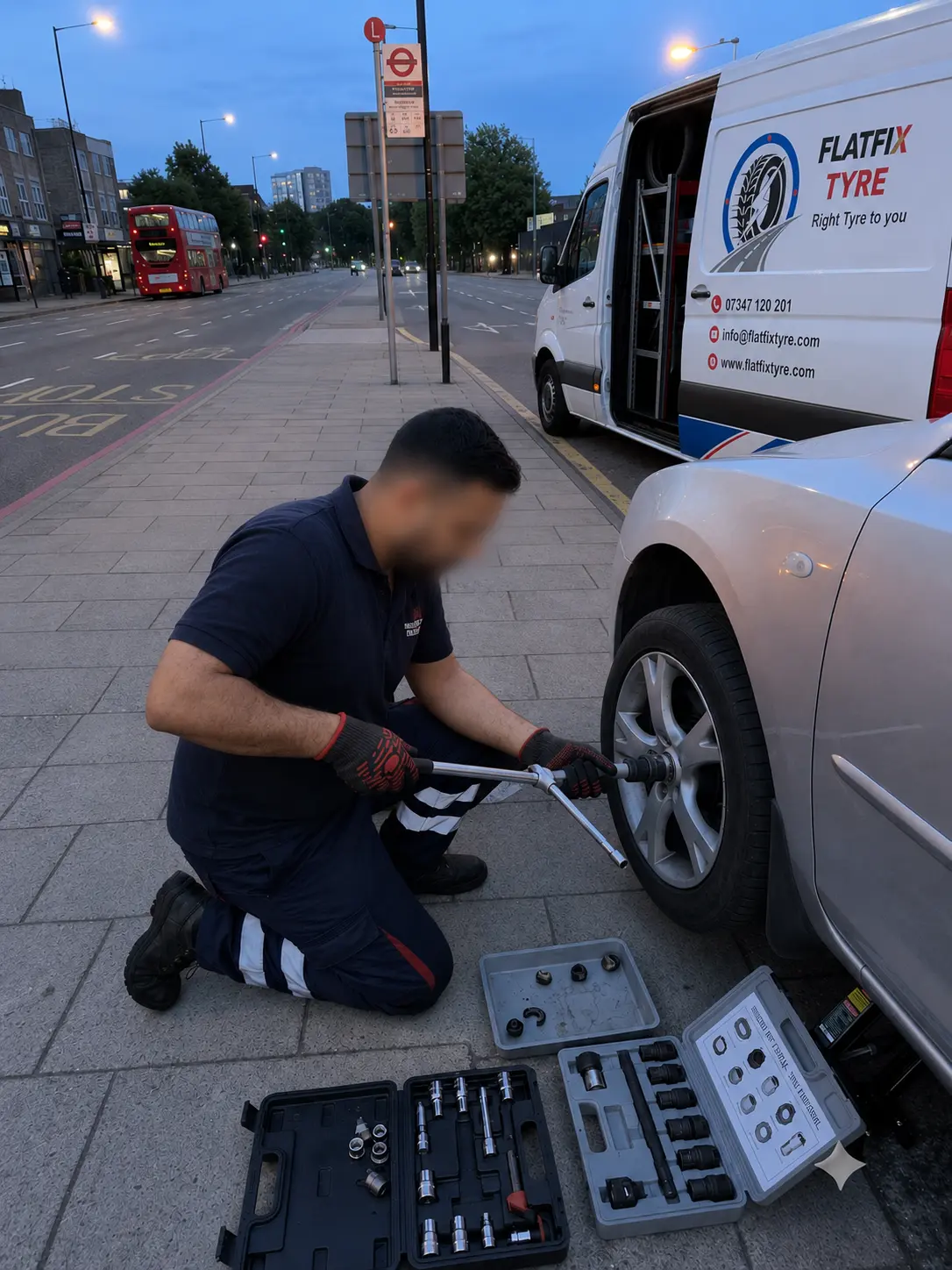 FlatFix Tyre provides mobile tyre fitting and tyre assistance at suitable locations across London.
Related FlatFix Tyre Guides
If you are researching a tyre that keeps losing air, the following FlatFix Tyre guides may also help you understand what to look for and what to do next.
7 Signs Your Car Tyres Are Unsafe to Drive On
How to Know When Your Car Tyres Need Replacing
Mobile Tyre Fitting vs Garage: Which Is More Convenient?
How Much Does Mobile Tyre Fitting Cost in London?
Flat Tyre on a London Road: What to Do and How to Get Help
Need Help With a Tyre That Keeps Losing Air?
If one of your tyres keeps losing pressure, speak with the FlatFix Tyre team about your vehicle, tyre condition and location.
Phone: 07347 120201
WhatsApp: Message FlatFix Tyre on WhatsApp
Email: info@flatfixtyre.com
Contact FlatFix Tyre Call 07347 120201Final Thoughts: Why Does a Car Tyre Keep Losing Air?
A car tyre can lose air for many different reasons, and not every air leak is immediately visible.
A nail or screw can create a slow puncture, while a damaged valve can allow air to escape without any obvious tread damage. Problems around the tyre bead, wheel damage after a pothole impact, sidewall damage, tyre deterioration and previous puncture repairs can also contribute to pressure loss.
Temperature changes can affect tyre pressure readings, but persistent pressure loss from one particular tyre should not simply be dismissed as a change in weather.
If you repeatedly need to inflate the same tyre, the most useful next step is to identify the cause of the pressure loss. Continuing to add air without investigating the problem may allow a developing tyre fault to go unnoticed.
If the tyre has lost significant pressure, is visibly damaged or has become completely flat, avoid unnecessary driving and arrange appropriate professional assistance.
For London drivers, FlatFix Tyre provides mobile tyre fitting, puncture repair and emergency tyre replacement at suitable home, workplace, car park and roadside locations across London.
Frequently Asked Questions About Tyres Losing Air
Here are answers to common questions about tyre pressure loss, slow punctures, leaking valves, damaged wheels and mobile tyre assistance.
1. Why does my car tyre keep losing air?
A tyre can repeatedly lose air because of a slow puncture, leaking valve, bead leak, wheel damage, sidewall damage, tyre deterioration or another fault affecting the tyre and wheel assembly.
2. Why is one tyre losing air but the others are fine?
If only one tyre repeatedly loses pressure, there may be a specific problem with that tyre, its valve, the bead area or the wheel. The tyre should be inspected to identify the source of the pressure loss.
3. Can a tyre lose air without a puncture?
Yes. Air can escape through a faulty valve, bead leak, damaged wheel, sidewall problem or other defect even when there is no obvious nail or screw in the tread.
4. What is a slow puncture?
A slow puncture is a tyre puncture that allows air to escape gradually rather than causing the tyre to become completely flat immediately. You may notice that the same tyre repeatedly needs to be inflated.
5. Can a nail cause a tyre to lose air slowly?
Yes. A nail or screw lodged in the tread can allow air to escape gradually. A professional inspection can determine whether the puncture is suitable for repair or whether the tyre needs replacement.
6. Should I remove a nail from my tyre?
It is better to have the tyre professionally assessed rather than simply removing an embedded object and continuing to drive. Removing the object may change the way air escapes from the tyre.
7. Can a damaged valve cause tyre pressure loss?
Yes. A faulty or damaged valve can allow air to escape gradually even when the tyre itself does not have an obvious puncture.
8. Can a pothole make a tyre lose air?
Yes. A significant pothole impact can damage the tyre, wheel or the seal between them. If a tyre starts losing pressure after hitting a pothole, the tyre and wheel should be inspected.
9. Is it safe to drive with a tyre that keeps losing air?
It depends on the pressure level and condition of the tyre, but persistent pressure loss should not be ignored. If the tyre is significantly underinflated, visibly damaged or completely flat, avoid unnecessary driving and arrange professional assistance.
10. Can I keep adding air to a leaking tyre?
Adding air may temporarily restore the pressure, but it does not fix the cause of the leak. If the same tyre repeatedly loses pressure, it should be inspected.
11. Can a slow puncture be repaired?
Some punctures can be repaired depending on their size, location and the condition of the tyre. A professional inspection is required before deciding whether repair or replacement is appropriate.
12. Can temperature changes cause tyre pressure to drop?
Yes. Changes in temperature can affect the pressure inside a tyre. However, persistent pressure loss from one particular tyre should still be investigated for a possible physical leak.
13. How often should I check my tyre pressure?
Tyre pressure should be checked regularly and according to the vehicle manufacturer's recommended settings. Checking before long journeys is particularly useful, and pressure should normally be checked when the tyres are cold.
14. Can mobile tyre fitting help with a tyre losing air?
Yes. Mobile tyre fitting can provide a convenient option when a vehicle has a puncture, damaged tyre or other tyre problem and attending a traditional tyre centre is inconvenient or unsuitable.
15. Does FlatFix Tyre provide puncture repair in London?
Yes. FlatFix Tyre provides mobile puncture repair at suitable locations across London, subject to the condition of the tyre and suitability of the repair.
16. Does FlatFix Tyre provide emergency tyre replacement in London?
Yes. FlatFix Tyre provides emergency tyre replacement across London, subject to tyre availability, location and safe working conditions.
17. Can a tyre look fine but still lose air?
Yes. Some air leaks are difficult to identify visually. A valve leak, bead leak, wheel problem or small puncture can allow pressure to fall while the tyre still appears normal.
18. What should I do if my tyre becomes completely flat?
Avoid driving on a completely flat standard tyre. Move to a safe location if possible and arrange appropriate roadside or mobile tyre assistance rather than continuing to drive on the flat tyre.
Tyre Keeps Losing Air? Let FlatFix Tyre Help
Have you noticed that one tyre keeps losing pressure, you have a suspected slow puncture or you cannot find where the air is escaping?
FlatFix Tyre provides mobile tyre fitting, puncture repair and emergency tyre replacement at suitable home, workplace, car park and roadside locations across London.
If your tyre has lost significant pressure or appears damaged, avoid unnecessary driving and arrange appropriate professional assistance.
Get Tyre Assistance in London Call 07347 120201WhatsApp: Message us on WhatsApp
Email: info@flatfixtyre.com