How to Read Tyre Sizes: A Simple Guide for UK Drivers
Finding the correct tyre size for my car is important when buying replacement tyres, but understanding the numbers and letters printed on a tyre can sometimes be confusing. Every tyre has markings on its sidewall that explain its width, profile, wheel diameter, load capacity and speed rating.
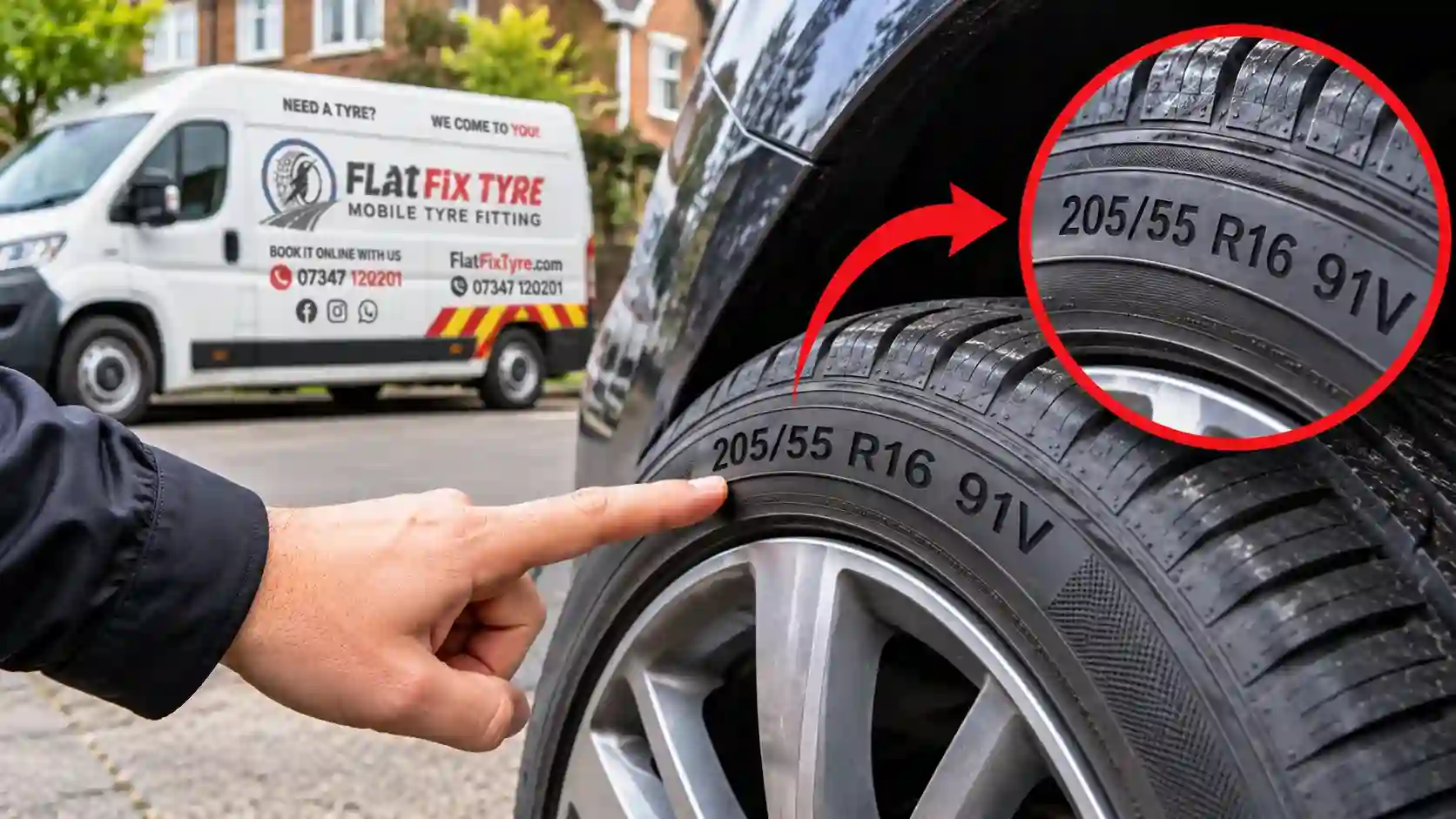
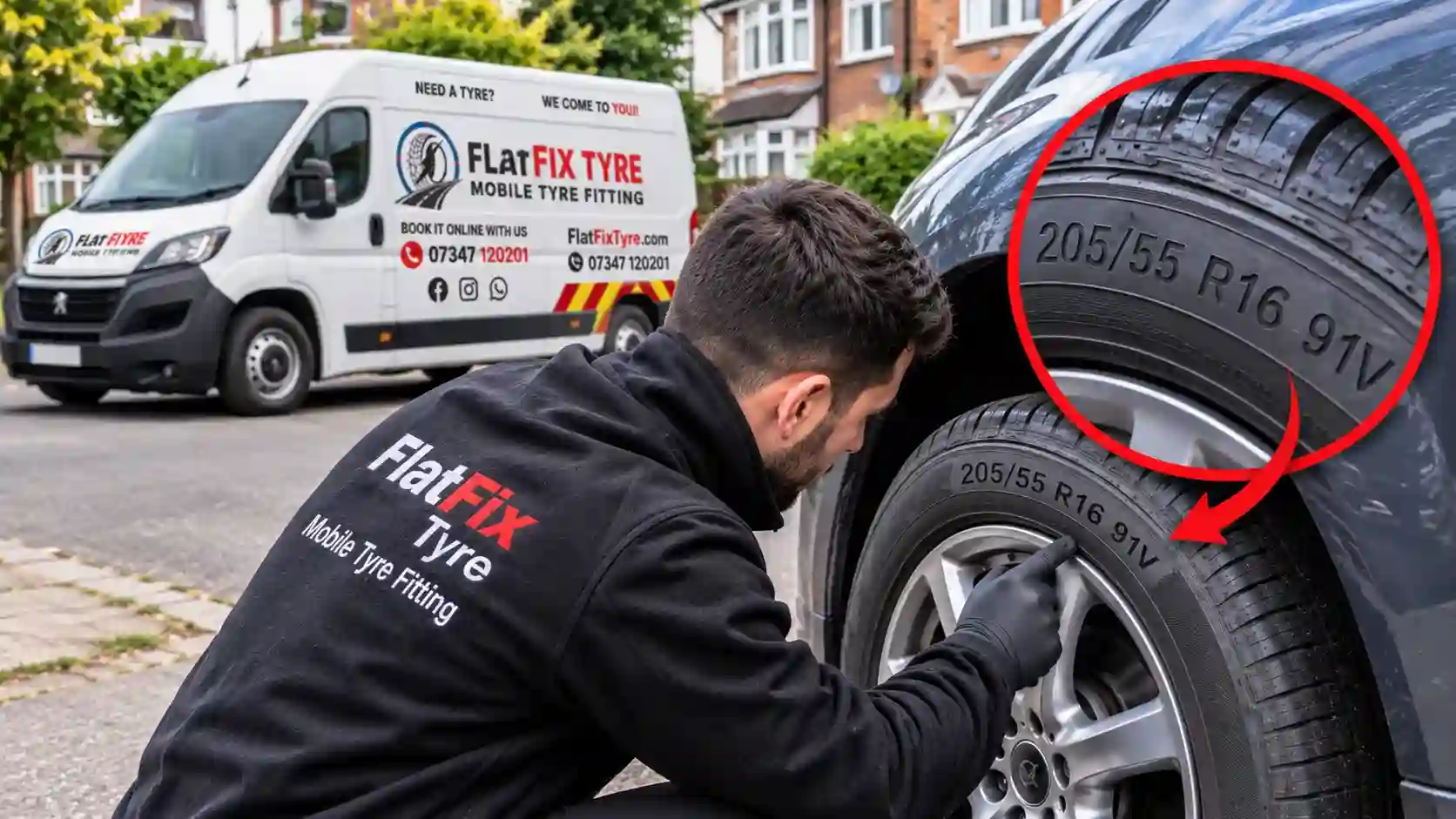
For example, you might see something like 205/55 R16 91V printed on your tyre. These markings are not random numbers. Each one provides information that helps you identify a suitable tyre for your vehicle.
Whether you are checking your tyres at home, comparing replacement options online or arranging mobile tyre fitting in London, knowing how to read tyre sizes can help you make a more informed decision.
In this guide, FlatFix Tyre explains what each number and letter means, where to find your vehicle's recommended tyre specifications and how to choose the right replacement tyres.
Not Sure Which Tyre Size Fits Your Car? Call Our Team
Don't risk ordering the wrong tyre dimensions. Call FlatFix Tyre with your vehicle registration or tyre sidewall markings—we will confirm the exact specification and arrange mobile fitting at your location.
24/7 London Mobile Tyre Assistance • Fast Dispatch & Upfront Quotes
Interactive Tyre Marking Decoder
Tap any number or letter in the example marking 205/55 R16 91V below to see what it tells you:
Click a Section of the Tyre Code
Explore each part of a standard UK passenger car tyre sidewall marking:
205 — Nominal Tyre Width (in Millimetres)
Measured straight across the tyre from outer sidewall to inner sidewall. A 205 marking means the tyre section is 205 mm wide.
Where Can You Find Your Tyre Size?
Before learning how to read tyre sizes, you need to know where to find the information. There are several places where you can check your vehicle's recommended tyre specifications.
1. Check the Tyre Sidewall
The easiest starting point is the sidewall of your existing tyre, where manufacturers display markings like 205/55 R16 91V. Turn your steering wheel to one side to read front tyres clearly.
Do not assume fitted tyres are automatically correct—a previous owner may have fitted a different size.
2. Check Your Vehicle Handbook
Your vehicle handbook lists recommended tyre sizes and specifications for your exact model, engine version, trim level, and wheel options.
3. Vehicle Information Label
Manufacturers often place a label inside the driver's door frame, door pillar, or fuel filler flap showing recommended pressures and approved sizes.
How to Read Tyre Sizes
A typical passenger car tyre marking looks like this: 205/55 R16 91V. At first, this combination might look complicated. However, each number and letter has a specific meaning.
Here is a simple breakdown:
| Tyre Marking | What It Means |
|---|---|
| 205 | Nominal tyre width in millimetres |
| 55 | Aspect ratio or profile |
| R | Radial construction |
| 16 | Wheel rim diameter in inches |
| 91 | Load index |
| V | Speed rating |
Understanding these markings makes it easier to compare suitable replacement tyres and check whether a particular specification is appropriate for your vehicle. Let's look at each part in more detail.
What Does Tyre Width Mean?
The first number in a tyre size represents its nominal section width in millimetres. In our example, 205/55 R16 91V, the number 205 means the tyre has a nominal width of 205 millimetres.
This measurement refers to the distance between the tyre's outer and inner sidewalls when fitted to an appropriate measuring rim. It is not simply the width of the tread. Tyre width matters because it affects how the tyre fits the wheel and interacts with the road. Choosing a tyre that is too wide or too narrow for your vehicle's approved specification can affect handling, clearance and safety.
Always check the manufacturer's recommended tyre width before selecting a replacement.
What Is Tyre Profile or Aspect Ratio?
The second number represents the tyre's aspect ratio, which is also known as its profile. In 205/55 R16, the number 55 means that the sidewall height is approximately 55% of the tyre's nominal width.
Profile Calculation Example (205/55 R16):
- Nominal tyre width: 205 mm
- Aspect ratio: 55%
- Approximate sidewall height: 205 × 55 ÷ 100 = 112.75 mm
A lower aspect ratio generally means a shorter sidewall, while a higher aspect ratio means a taller sidewall.
The profile influences the tyre's overall dimensions, ride comfort and handling characteristics. However, you should never change the profile simply because another size looks suitable. Any alternative must be approved for your vehicle and compatible with its wheels and other requirements.
What Does R Mean on a Tyre?
The letter R stands for radial construction. Radial tyres are commonly used on modern passenger cars. Their internal reinforcing cords are arranged radially across the tyre structure, providing the flexibility and performance characteristics expected from modern car tyres.
When checking your tyre markings, remember that R describes the construction type, not the tyre's diameter or width.
What Does the Number After R Mean?
The number immediately after R represents the wheel rim diameter in inches. In our example, 205/55 R16, the number 16 means the tyre is designed to fit a wheel with a 16-inch rim diameter.
This measurement is particularly important when ordering replacement tyres. A tyre designed for a 16-inch wheel cannot simply be fitted to a 17-inch wheel. The tyre and wheel must be compatible. Always check the complete specification before buying replacement tyres.
What Are Tyre Load Index and Speed Ratings?
After the main tyre dimensions, you will normally find additional numbers and letters. In our example, these are 91V. They represent two important specifications: the load index and speed rating.
Understanding the tyre load index
The load index is a numerical code that indicates the maximum load a tyre can carry under specified conditions. For example, a load index of 91 corresponds to 615 kg per tyre. This is the individual tyre's rated load capacity, not the vehicle's permitted carrying capacity. The vehicle's maximum permitted weight and axle limits must also be considered.
Understanding the tyre speed rating
The speed rating is represented by a letter. It indicates the maximum speed at which the tyre can carry its rated load under specified test conditions. For example, the letter V represents a maximum rated speed of 240 km/h (149 mph). This is a technical tyre classification, not a recommendation to drive at that speed.
| Speed Rating | Maximum Rated Speed |
|---|---|
| T | 190 km/h (118 mph) |
| H | 210 km/h (130 mph) |
| V | 240 km/h (149 mph) |
| W | 270 km/h (168 mph) |
| Y | 300 km/h (186 mph) |
Always choose a speed rating that meets the vehicle manufacturer's requirements and applicable regulations. Do not assume that a lower rating is suitable simply because you normally drive below that speed. For more information, read Michelin's guide to tyre load and speed ratings.
Need Help Confirming Your Load Index or Speed Rating?
Call our London tyre specialists on 07347 120 201. We will verify your manufacturer-approved size and quote you for mobile fitting at your home or workplace.
How to Find the Right Tyre Size for My Car
If you are searching for the correct tyre size for my car, it is important to check the complete specification rather than relying on one number printed on the sidewall. Follow these five steps before ordering replacement tyres:
- Identify your current tyre markings: Look at the sidewall and write down the complete marking, including the width, profile, rim diameter, load index and speed rating (for example, 205/55 R16 91V).
- Check your vehicle handbook: Compare the marking with the tyre specifications recommended by your vehicle manufacturer, paying attention to differences between engine versions, trim levels and wheel options.
- Verify the load index and speed rating: Check that the replacement tyre meets the manufacturer's specified load and speed requirements.
- Check the front and rear tyre specifications: Some vehicles have different approved tyre sizes for their front and rear wheels. Do not assume all four tyres must have identical markings.
- Ask a tyre professional if you are unsure: If the information is unclear, or your existing tyres do not match the manufacturer's recommendations, seek professional advice before purchasing replacements.
Can I Fit Different Tyre Sizes to My Car?
Some manufacturers approve more than one tyre size for a particular vehicle depending on its model, engine or optional equipment. However, this does not mean you can choose any alternative size.
Changing tyre dimensions without checking compatibility can affect:
- Speedometer accuracy.
- Handling and steering response.
- Braking performance.
- Clearance around the wheel arches and suspension.
- Vehicle stability systems.
- Overall rolling diameter.
Some vehicles also require particular tyre specifications, including reinforced or run-flat tyres. Before changing tyre sizes, check the manufacturer's approved fitment information and speak to a qualified tyre professional.
Why Is Choosing the Correct Tyre Size Important?
Your tyres are the only parts of your vehicle that make direct contact with the road. Therefore, choosing the correct specification is essential. Here are four important reasons to get the size right:
1. Safety and Handling
Helps maintain the vehicle's intended handling, steering and braking characteristics, particularly during emergency manoeuvres.
2. Comfort and Driving Performance
Maintains the balance between ride comfort, handling and performance intended by the manufacturer.
3. Fuel Efficiency
Influences rolling resistance, though tyre pressure, driving style, road conditions and vehicle condition also affect fuel economy.
4. Avoiding Incorrect Purchases
Understanding markings makes it easier to compare options and reduces the risk of ordering a tyre that does not fit your wheel.
Common Mistakes to Avoid When Reading Tyre Sizes
Even experienced drivers can make mistakes when checking tyre specifications. Here are some common problems to avoid:
- Only checking the width: The width alone does not tell you the complete tyre specification.
- Ignoring the load index: A replacement tyre must meet your vehicle's load requirements.
- Overlooking the speed rating: The replacement must meet the manufacturer's requirements.
- Assuming the existing tyre is correct: Previously fitted tyres may not match the approved specification.
- Confusing inches and millimetres: Tyre width is expressed in millimetres, while wheel diameter is expressed in inches.
- Ignoring different front and rear specifications: Some vehicles require different sizes on each axle.
- Choosing a tyre based only on appearance: A tyre that looks similar may not be suitable for your vehicle.
Helpful Tip: Taking a few minutes to check the full markings—or calling 07347 120 201—can help you avoid unnecessary delays when buying replacement tyres.
Frequently Asked Questions About Tyre Sizes
Check your vehicle handbook, manufacturer's tyre specifications or vehicle information label. You can also inspect the existing tyre sidewall, but always verify that the fitted tyre matches the manufacturer's approved specification.
Your tyre size is printed on the sidewall of your tyre. You may also find the recommended specifications in your vehicle handbook or on a manufacturer's information label.
It means the tyre has a nominal width of 205 mm, an aspect ratio of 55%, radial construction and a 16-inch wheel rim diameter. If the complete marking is 205/55 R16 91V, 91 is the load index and V is the speed rating.
Only if the alternative size is approved for your vehicle and compatible with its wheels and other requirements. Always check the manufacturer's recommendations before changing tyre sizes.
Yes, tyre dimensions and design can influence rolling resistance and fuel consumption. However, tyre pressure, driving conditions and driving habits also have an important effect.
Not always. Some vehicles have different manufacturer-approved tyre sizes for the front and rear axles. Check your vehicle's specifications before ordering replacements.
Write down the complete marking on the tyre sidewall, including the width, profile, rim diameter, load index and speed rating. Then compare it with the manufacturer's approved specifications.
Tyre width is the nominal measurement across the tyre in millimetres. The profile, or aspect ratio, is the sidewall height expressed as a percentage of the tyre's nominal width.
Get Help Finding the Right Tyres with FlatFix Tyre
Understanding tyre markings is a useful first step, but choosing the right replacement also means making sure the complete specification is suitable for your vehicle. If you need help identifying the correct tyres or arranging a replacement, FlatFix Tyre can help with its tyre services.
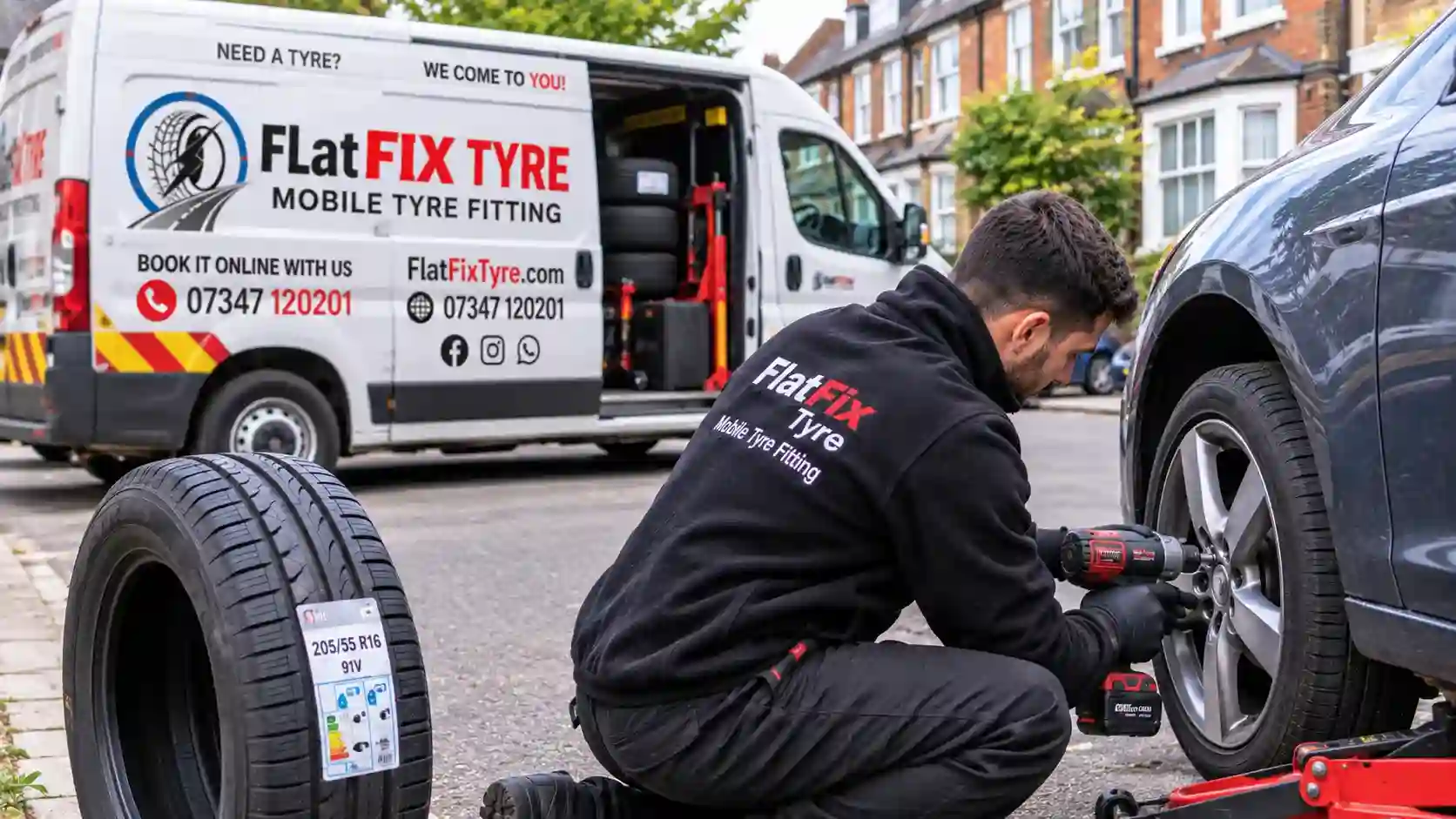
Whether you need a replacement tyre at home, at work or while travelling around London, explore our mobile tyre fitting service and mobile tyre services.
If you are unsure whether your tyres need replacing, read our guide on how to know when your car tyres need replacing. You can also find out more about mobile tyre fitting costs in London before arranging your replacement.
Need Help Finding the Right Tyre for Your Car?
Call FlatFix Tyre now for professional assistance, instant size verification, and mobile tyre fitting at your home, workplace, or roadside across London.
Call Direct: 07347 120 201 | Email: info@flatfixtyre.com